American Indian languages
 Indian nations
American Indian genealogy
Indian nations
American Indian genealogy

Painting With Mysterious Words


These are pictures of a badly damaged painting, apparently of a Native American couple sitting by the water.
At the bottom is a flag-like rectangle rimmed with curious words and undecipherable squiggles. It is difficult to see all
of them in this photo, but the owner of the painting reports the words as reading "Hacroia, Floury, Umychol,
Sehey, Cilelm, Yakachym, Yaha, Yehay, Chanany, Yeschayah." The painting was found in Arkansas, and the owner
wonders if the painting could be Choctaw or Cherokee.
Answer 1: Definitely not Choctaw or Cherokee, sorry. The words are not Choctaw or Cherokee, the squiggles
do not resemble the Cherokee syllabary,
and though it's hard to see the figures (especially the man,) they really don't bear any resemblance to Choctaw or
Cherokee attire. Looks more like a non-Native artist's depiction of a Plains Indian couple.
Answer 2: I have an answer for you, but I'm pretty sure it's not the one you were expecting. :-) The words
are definitely not Choctaw or Cherokee. Some of them looked a little like Hebrew words to me, and when I
investigated that angle, it led me to 18th-century books of crypto-Christian mysticism called the
"Sixth and Seventh Books of Moses"
These texts are apparently of German origin, but they are better known after being adopted by African-American slaves
and early African-American post-slavery communities and spread throughout the American South and the Caribbean as
part of African-American/Afro-Caribbean folk tradition.
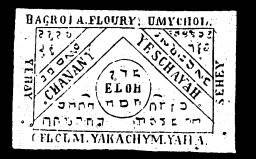
The words you list are indeed corrupted Hebrew words from the original illustrations in this book. Here's the original
image, part of an incantation to water spirits:
Follow-up: Thanks for all the great information. I can't believe you found this! Do you know exactly what the
words mean....in English?
Answer: Not really. The text in the original book reads "Spirits of Water, Conjuration: I call upon and command
thee Chananya by God Tetragrammaton Eloh. I conjure Thee Yeschaijah by Alpha and Omega, and Thou art compelled
through Adonai." To me, that makes it sound like "Chananya" and "Yeschaijah" are some kind of demons or spirits that
are supposed to be controlled by invoking God ("Adonai" and "Eloh" come from Hebrew names for God) and Jesus
("Alpha and Omega" is a Biblical reference to Jesus.) The language kind of reminds me of the Exorcist, to be honest with
you ("The power of Christ compels you!") The drawing is reminiscent of
pentagrams. I'd guess that the words
around the border are supposed to be some of the sacred names of God, and probably are corruptions of Hebrew words.
I found a second picture of the same thing, with differently spelled words:
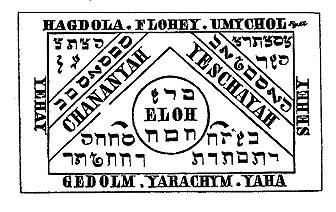
Putting the three together, "Hacroia," "Bagroia," and "Hagdola," for example, might be progressively corrputed versions
of HaGadol, which means "Great" in Hebrew and is one of the traditional names of God. "Flohey" and "Floury" might be
progressively corrupted versions of Elohei, another Hebrew name for God. They probably all go along like that (the
squiggles, too, seem to have progressively deteriorated from designs that originally resembled Hebrew characters.)
"Chananyah" is a Biblical name (also spelled Hananiah.) It's the name of many different Biblical characters, so it's hard
to know which, if any of them, it's referring to here. I suspect "Yeschayah" of being a corruption of Yeshaya, the prophet
whose name became Isaiah in English. This book had Germanic origins, as I mentioned before, and "sch" makes a "sh"
sound in German. So they're definitely Biblical given names, but I have no idea if they're supposed to be referring to
the actual Biblical figures or if they're just Hebrew names picked at random to be the names of these water spirits.
The text below definitely makes it sound like these two are supposed to be controlled by the spell and by the
invoking of divine power to contain them, then the illustration literally contains them within the ring of divine names,
so it seems weird to me that German occultists would have been trying to conjure and enslave the ghost of Isaiah the prophet,
but never having even heard of these books before today, I really couldn't speculate usefully on why they
wrote any of this or what their intent was!
Thanks for the help! If anyone has more information about this painting or the conjuring spell depicted on it,
please let me know. Thank you!

Ask an Indian art identification query
Back to our American Indian painting page
Back to our American Indian websites for kids

Native Languages of the Americas website © 1998-2020  Contacts and FAQ page